Are You Attractive? AI Scanner
- 4.1
- Rating
- 100.00K
- Installs
- Free
- Price

 Analysis by App-foxy
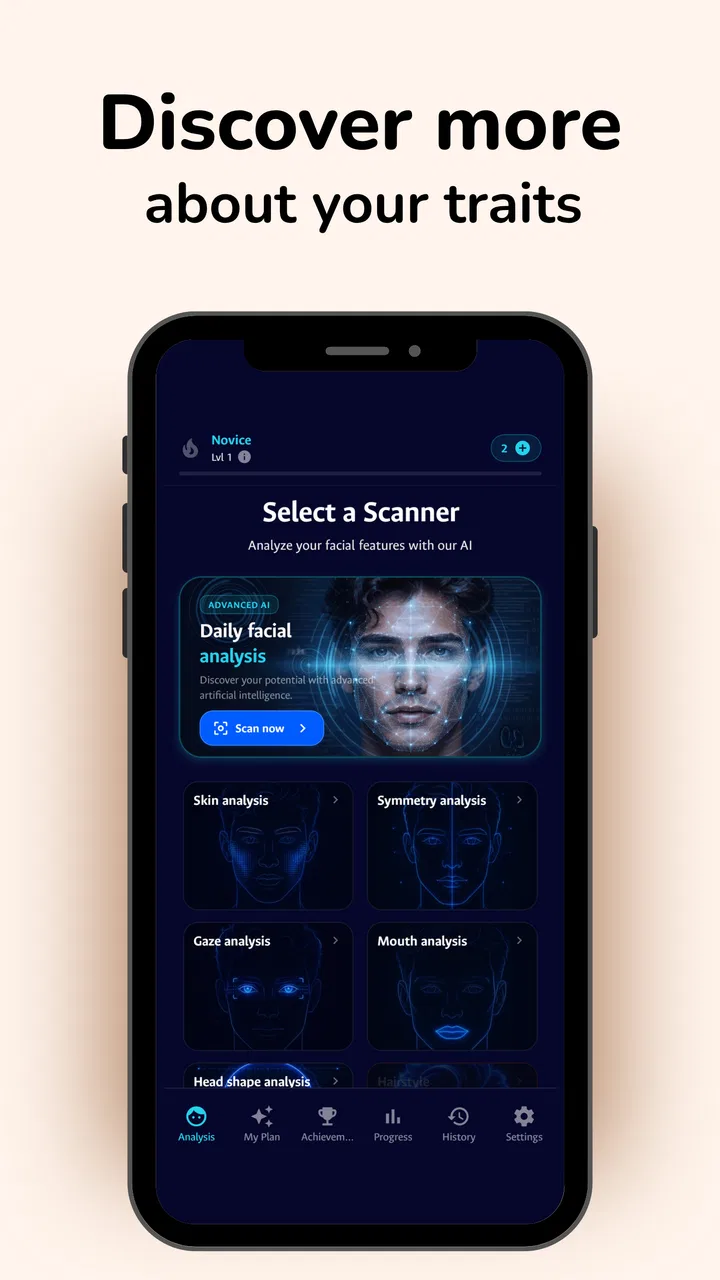
I tried Are You Attractive? AI Scanner as a lighthearted beauty app rather than as a serious authority on appearance. Its central idea is simple: use an AI-based scan to offer an impression of attractiveness. That makes it easy to understand, quick to approach, and potentially fun to use when curiosity is the main goal. It is also the kind of app that needs to be treated with a little distance, because a computer-generated result cannot define someone’s real appeal.
The app comes from Molly Digital and sits in the beauty category. It is free to install, which is the most important part of its value proposition: you can try the experience without committing money first. The audience is broad as well, since its content rating is Everyone. On compatible devices, the app requires Android 7.0 or later, and the current release is version 2.2.1.
After its release on October 27, 2024, it attracted more than 50 thousand installs and an average score of 4.1 from roughly 994 ratings. Those figures suggest that the concept has found an interested audience, while also reminding me that this is a novelty beauty tool, not a professionally validated assessment.
You May Also Like

 Blood Strike: 2.5 Anniversary
Blood Strike’s Loadouts Turn Every Drop Into a Tactical Gamble
A close look at Blood Strike’s custom loadouts: how fast access to signature weapons reshapes its battle royale rhythm, rewards preparation, and narrows the gap between fights.

 Pandora - Music & Podcasts
Pandora’s Music Is Easy to Start, but Harder to Recover
Pandora’s strength is its low-effort path from a seed to a station. Its weak spot is how much confidence it asks you to place in connection, setup, and quiet recovery.

 8 Ball Pool
 Is Built on Rivalries, Rematches, and Routine
A close look at the rivalries, rematches, shared routines, and unanswered safety questions that turn a quick pool match into a persistent mobile community.

 Samsung Music
’s Quiet Strength Is Playing What You Already Own
Its reach comes less from spectacle than from dependable access to a personal library. That simplicity is both the app’s strongest retention engine and its ceiling.

 AccuWeather: Weather Radar
AccuWeather Review: A Quick, Clear Forecast for Everyday Decisions
For everyday plans, the best forecast is the one you can understand quickly. AccuWeather makes rain timing, radar, and local conditions easy to act on, with a few trade-offs.

 Hill Climb Racing
Why Hill Climb Racing Still Turns Crashes Into One More Run
A tiny car, a bumpy hill and one more upgrade: Hill Climb Racing keeps resurfacing because its simple chaos makes every near-miss feel personal.
More From Our News Desk



How the AI beauty scan feels in everyday use
The appeal is immediate. Instead of opening a large beauty suite filled with editing controls, you come to the app with one question: what will the scanner say about my appearance? That focused purpose makes the experience easier to understand than many conventional beauty apps, which often combine filters, retouching, makeup effects, social sharing, and photo editing in one crowded interface.
I see the best use case as a short, private experiment. You might be getting ready with friends, testing a new profile photo, or simply wondering how an automated beauty tool interprets a particular image. In that situation, the app provides a playful prompt for conversation. The result can be amusing or interesting, but I would not use it to decide whether a photo should represent me professionally or whether I look “good enough” to go out.
A practical workflow is to keep the test consistent. Use a clear, front-facing image with ordinary lighting, then compare the result with another image taken under different conditions. This is a useful way to notice how strongly the scan may depend on presentation. A shadow, camera angle, expression, or distance from the lens can change the impression of a portrait even when the person has not changed at all.
That comparison is one of the more valuable ways to use the app. Rather than asking it for a final judgment, treat it as a demonstration of how image-based systems react to visual input. If one picture produces a more flattering response than another, the lesson may be about lighting and framing rather than about your face. This makes the app more interesting than simply running one scan and accepting the output as a fact.
I would also avoid using a group photo for a personal conclusion. When several faces or distracting backgrounds appear in an image, the result may be harder to interpret. A single subject and a straightforward portrait create a cleaner test, even though they still cannot turn an automated impression into an objective measurement.
What the free price really means
Because the app is free, the decision to try it is relatively easy. There is no purchase price to weigh against a professional service, a full photo editor, or a long-term beauty routine. For someone who only wants a quick curiosity-driven experience, that makes the app accessible and low risk from a financial point of view.
Free access does not automatically make every result valuable, though. The real question is whether you want entertainment, experimentation, or dependable guidance. For entertainment, the app can be worthwhile because the scan gives you something concrete to react to. For dependable guidance about skincare, makeup, facial health, or personal presentation, a specialist resource would be a better choice. The app’s value is therefore tied to your expectations, not just to the absence of a price.
I would not install it expecting a complete beauty consultation. A scanner can provide a momentary assessment, but it does not replace a dermatologist, makeup artist, stylist, photographer, or trusted friend. It also should not be used as a basis for judging another person. The most responsible approach is to keep the result personal, temporary, and clearly separate from self-worth.
There is another subtle point about free apps in this category: the emotional cost can matter more than the financial one. If a result makes you feel worse, the experience has failed its purpose even though the download cost nothing. I recommend trying it only when you are comfortable treating the output as an algorithmic opinion. If you already feel anxious about your appearance, a tool built around attractiveness scoring may not be a helpful choice.
Where it differs from ordinary beauty apps
Traditional beauty apps usually help you change an image. They may let you adjust color, smooth skin, add makeup, reshape features, or create a more polished portrait. This scanner takes a different route: its attraction comes from evaluation rather than editing. That distinction matters. An editor gives you control over the result, while a scanner asks you to observe what the system produces from the image you provide.
For a quick “what does the AI think?” moment, that narrower focus is convenient. You do not need to learn a collection of editing tools before getting to the main point. On the other hand, the app is less useful if your real goal is to improve a photograph. In that case, a dedicated editor is more practical because it lets you correct lighting, crop the frame, or make deliberate visual choices instead of merely receiving an assessment.
It also differs from social beauty filters. Filters are often designed to create an immediately attractive version of a face, while an AI scanner is framed around analyzing the submitted image. I would keep those experiences mentally separate. A flattering filter can show what a visual effect does; a scan can show how an automated system responds. Neither one is a neutral description of a person.
That trade-off gives the app a specific niche. It is not the strongest option for building a polished portfolio image, planning a skincare routine, or learning makeup technique. It is better suited to people who enjoy testing AI tools and want a compact beauty-themed experiment without paying to begin.
Small details that improve the experience
First, test images under similar conditions if you want a meaningful comparison. Changing the room, time of day, camera height, and facial expression all at once makes it impossible to know what influenced the outcome. A simple sequence of portraits, with one variable changed at a time, turns a casual scan into a more revealing experiment.
Second, use the app to examine presentation choices rather than personal value. Try a neutral expression, a smile, a closer crop, and a slightly wider frame. If the results differ, you have learned something about how portrait composition affects automated interpretation. That is a more constructive takeaway than chasing a particular response.
Third, do not repeatedly rescan until you receive an answer you like. That habit can turn a playful activity into reassurance-seeking. Set a limit before you begin, look at the result once or a small number of times, and then move on. This is especially important for younger users, even though the app is rated for Everyone.
Fourth, think carefully before using a photo that you would not want to reuse elsewhere. I would choose an ordinary test image rather than a sensitive portrait, an identity document, or a picture containing someone who has not agreed to participate. This is a sensible privacy habit for any image-based tool, and it avoids turning a casual experiment into an uncomfortable situation.
Finally, remember that the same face can look very different across cameras and screens. A front-facing phone lens, a low-light room, and a compressed social-media image each present a different visual input. If you are using the scan to choose a profile picture, compare the actual image at the size and crop where people will see it instead of relying only on the app’s reaction.
Who will get the most from it
The strongest audience is curious users who enjoy lightweight AI experiments. If you like trying unusual apps, comparing portrait styles, or sharing a harmless result with friends, the free entry point makes this an easy addition to your phone. It can also be useful for someone learning that small changes in lighting and framing affect automated image analysis.
It may appeal to teenagers and families looking for a simple conversation starter, but I would encourage adults to set the tone. The result should be presented as entertainment, not as a ranking of people. A child who is still developing confidence may take an attractiveness score more seriously than intended, so supervised and supportive use is wiser than leaving the result to speak for itself.
People choosing a new profile photo may also find a limited benefit. The scan can encourage you to compare expressions and compositions, but I would combine it with your own judgment. A good profile image needs to communicate personality, clarity, and context; attractiveness alone is not enough. In many cases, a natural photo that looks like you will serve you better than one selected only because an algorithm responded favorably.
The app is less suitable for anyone seeking medical, cosmetic, or psychological advice. It cannot replace professional evaluation, and it should not be used to diagnose skin concerns or justify a cosmetic decision. It is also a poor fit for users who dislike appearance-based scoring or who know that numerical or judgment-oriented feedback affects their mood.
Photographers and creators may prefer a standard editing application. Their needs are usually concrete: exposure correction, color balance, cropping, retouching, and export control. A scanner can be a secondary curiosity, but it does not address those practical tasks as directly as an editor does.
My balanced verdict
My view is that Are You Attractive? AI Scanner delivers a clear kind of value: a free, focused experiment for people who want to see how an AI beauty tool reacts to a portrait. It is easy to understand, does not require a financial commitment to try, and can become more interesting when used to compare lighting, angles, expressions, and framing rather than to seek a definitive judgment.
The limitations are just as important. An attractiveness result is inherently narrow, and the app cannot account for personality, confidence, kindness, style, cultural context, or the many qualities that shape how people experience one another. Results may also encourage unhelpful comparison if the user treats them too seriously. For that reason, I would use it briefly and playfully, not as a daily check-in or a source of self-esteem.
With its 4.1 average and more than 50 thousand installs, the app has enough public interest to make it worth considering for curious Android users whose devices meet the minimum requirement. I would recommend it to someone who wants a no-cost AI beauty experiment and understands the result as an opinion generated from one image. I would skip it if I wanted reliable beauty advice, professional photo improvement, or anything that could responsibly define how attractive I am.
My final recommendation is simple: try it for curiosity, keep your expectations modest, and let your own judgment remain more important than the scan. That is where the free experience makes sense, and it is also the boundary that keeps this beauty app enjoyable rather than emotionally overpowered.
FAQs for Are You Attractive? AI Scanner
01What is 'Are You Attractive? AI Scanner' and how does it work?
'Are You Attractive? AI Scanner' is an app that uses advanced artificial intelligence algorithms to analyze your facial features and provide a score or feedback on your attractiveness. The app employs facial recognition technology to assess various elements like symmetry, proportion, and unique traits. It's important to understand that the results are meant for entertainment and should not be taken as definitive assessments.
02Is 'Are You Attractive? AI Scanner' safe to use regarding privacy?
The app claims to prioritize user privacy by ensuring that photos are processed locally on your device and not stored or shared without consent. However, it's essential to review the app's privacy policy and permissions carefully before using it. This way, you can ensure that your data and images are handled securely and in line with your comfort level.
03Can the results of 'Are You Attractive? AI Scanner' affect my self-esteem?
While the app is designed for entertainment, it's crucial to remember that attractiveness is subjective and cannot be accurately measured by an algorithm. The feedback provided should not impact your self-esteem or self-image. Users are encouraged to use the app lightly and not let the results influence their perception of themselves or others.
04Are there any costs associated with using 'Are You Attractive? AI Scanner'?
The app is available for free with basic features; however, it may offer in-app purchases or a premium version that provides additional features or an ad-free experience. It's advisable to check the pricing details within the app store or the app itself to understand any potential costs before downloading.
05Is 'Are You Attractive? AI Scanner' available for both Android and iOS devices?
Yes, 'Are You Attractive? AI Scanner' is available for download on both Android and iOS platforms. Users can find it on the Google Play Store for Android devices and the Apple App Store for iOS devices. Ensure that your device meets the app's system requirements for optimal performance.
Pros
- Simple and user-friendly interface.
- Quick and easy scanning process.
- Provides detailed feedback instantly.
- Fun to use with friends or alone.
- No account registration required.
Cons
- Results can feel subjective.
- Limited features in free version.
- Requires good lighting for best results.
- Ads can be intrusive at times.
- May not work well on older devices.

Are You Attractive? AI Scanner
Gallery